



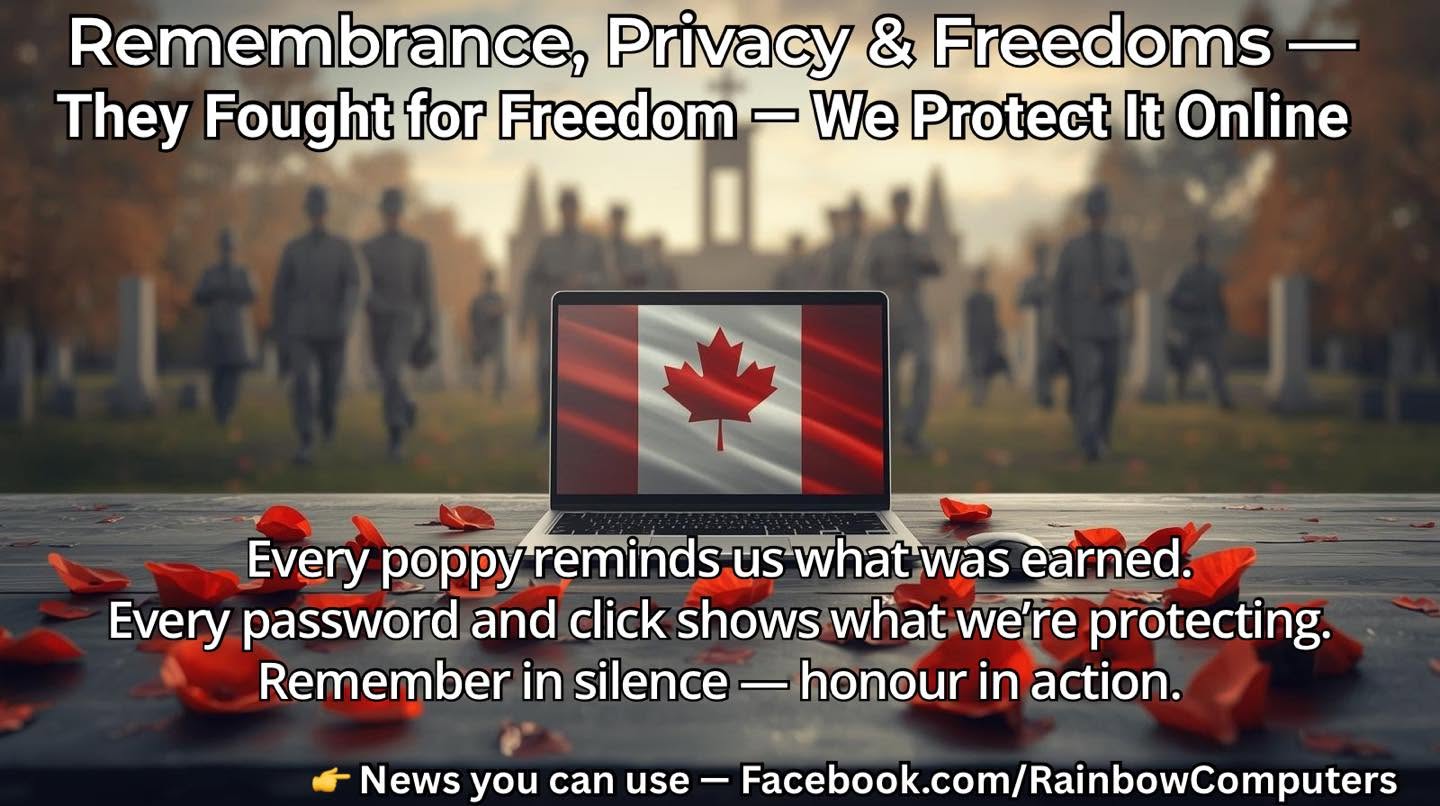
The Price of Freedom — They Fought for Freedom, We Protect it Online
Freedom was never free.
It was fought for, defended, and passed down — sometimes at an impossible cost.
And while the world looks different today, the duty remains the same: protect what was earned.
⸻
 The Battlefield Has Changed
There are no trenches, no air raids, no uniforms in this fight.
The new front line runs through our devices — through passwords, privacy settings, and what we choose to share.
Every login is an act of trust.
Every “I agree” box and app permission is a decision that shapes how freely we can live, work, and speak online.
⸻
 What “Freedom” Means in the Digital Age
Our grandparents fought to defend borders and democracy.
We protect data and autonomy.
The threats today don’t fly overhead — they hide in inboxes, pop-ups, and texts designed to trip the distracted.
Nearly 40 percent of Canadians reuse the same password across multiple accounts.
That’s not just lazy — that’s an unlocked door.
Freedom now includes the right to decide who sees your data and how it’s used.
⸻
 The New Front Line — Everyday Defenders
You don’t need a uniform to stand guard anymore.
Defending your privacy today means smart, steady habits — not just running antivirus once a year.
• Check your passwords. Use a manager only if it’s reliable and actually helps you.
Some do. Others don’t. We’ve had customers calling once or twice a month because their Symantec password manager either locked them out of their accounts or refused to connect to their online banking.
If your password manager keeps you out more often than the hackers do, that’s not security — that’s sabotage.
Best approach: use a strong passphrase (a short sentence with symbols) alongside a trusted password manager. Together, they provide both memorability and structure.
• Stay skeptical. If an email, ad, or “urgent alert” feels off, it probably is. Hover before clicking, check the sender, and when in doubt, make a phone call.
• Back up what matters. Keep both a local copy and a cloud copy — never just one.
• Support Canadian-based services. Data stored here stays under Canadian privacy law — though no system is bulletproof.
PIPEDA doesn’t guarantee full data residency; some services still process data abroad through third-party providers. Always review a platform’s privacy policy and terms to know where your information actually lives.
• Talk to family. Five minutes explaining phishing scams can save them thousands.
⸻
 Honouring the Fallen by Protecting the Living
They fought for freedom; we protect it by staying alert.
It’s not the same kind of war, but the stakes are still real.
A stolen identity can wreck a life as surely as a broken lock can ruin a home.
Freedom isn’t only won on battlefields — sometimes it’s kept alive at the login screen.
⸻
 Remembrance Day Challenge — One Day Offline
Last week, we invited readers to go One Day Offline — a small, symbolic gesture of respect.
Can you do it this Remembrance Day?
Spend the time you’d normally be scrolling doing something that truly honours the spirit of the day.
Visit a cenotaph, call a veteran, or simply sit in quiet gratitude.
Because remembrance doesn’t always require words — sometimes, silence says more.
We remember in silence. We honour in action.
⸻
 The Takeaway
The tools have changed — the duty hasn’t.
Whether you’re guarding a border or guarding your inbox, vigilance keeps us free.
And in this digital age, remembrance isn’t just about poppies — it’s about protecting the world those poppies represent.